A Great Haircut Should Make Everyday Care Easier
Custom haircuts and styling can do more than create a flattering finish for one day; the right design can make washing, drying, shaping, and refreshing your hair feel far more manageable.
That practical benefit deserves more attention. Hair is part of a daily routine, and a cut that requires an hour of effort when you normally have ten minutes is unlikely to feel satisfying for long. A personalized approach considers how hair behaves between salon visits, not just how polished it looks when professionally styled.
The goal is not to find a supposedly perfect haircut for a face shape. It is to balance texture, density, growth patterns, preferred length, lifestyle, and the amount of styling you genuinely enjoy doing.
Begin With Your Real Routine
A useful consultation starts with ordinary life. How often do you wash your hair? Do you air-dry, diffuse, blow-dry, or use an iron? Does your work require hair to be tied back? Are you growing out color, managing humidity, exercising frequently, or caring for young children while getting ready?
These questions are not small talk. They help determine whether a shape will be easy to repeat at home. Before choosing a cut, be honest about:
- How many minutes you usually spend styling
- Which tools you know how to use comfortably
- How your hair behaves on the second or third day
- Whether you regularly wear ponytails, buns, braids, hats, or head coverings
- Which part of your current routine causes the most frustration
A photo of your hair on a normal morning can be more informative than a carefully styled selfie. It shows the stylist where volume collapses, where curls separate, and which sections tend to flip or frizz.
Texture, Density, and Strand Size Are Different
Hair descriptions can become confusing because several characteristics are often bundled together. Texture may refer to a straight, wavy, curly, or coily pattern. Density describes how much hair grows across the scalp. Strand size describes whether individual fibers feel fine, medium, or coarse.
Someone can have fine strands and high density, or coarse strands and lower density. Those combinations affect weight, movement, drying time, and how strongly layers appear.
The University of Virginia’s overview of hair chemistry explains that follicle shape and chemical bonds within keratin help influence natural texture. Water and heat temporarily rearrange weaker bonds, which is why hair can take on a new shape as it dries and then respond again to humidity or washing.
A personalized cut works with that behavior. It may remove bulk without sacrificing the perimeter, preserve enough weight to control expansion, or create movement where dense hair tends to sit heavily.
A Haircut Is a System of Weight and Movement
The Perimeter Creates the Outline
The perimeter determines the visible edge of the haircut. A strong line can make fine hair appear fuller, while a softer edge creates movement. Length also affects whether the hair clears the shoulders, rests on them, or repeatedly flips against clothing.
Layers Redistribute Weight
Layers are not automatically the answer to heaviness, nor are they always a threat to fullness. Their effect depends on where they begin, how much hair is removed, and how the sections connect. Long internal layers can encourage movement while preserving an outer shape. Shorter layers may support lift or reveal more curl, but they also change the styling pattern.
Growth Patterns Influence the Details
Cowlicks, crowns, hairlines, and natural partings can redirect a fringe or cause one side to sit differently. A bang that behaves beautifully in a reference photo may need a different length or weight on someone with a strong front growth pattern.
Seeing the haircut as a system makes it easier to describe a goal. “I want less bulk behind my ears but enough length for a low ponytail” is more actionable than simply asking for more layers.
The Best Styling Lesson Uses Your Own Hands
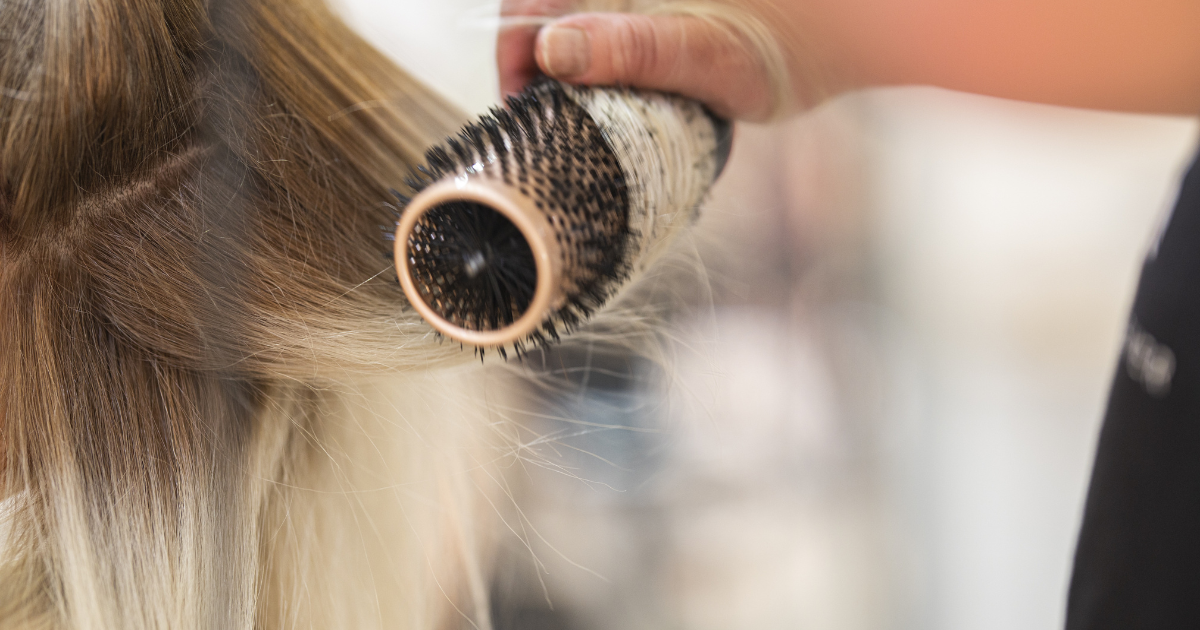
A salon finish is most valuable when it teaches you something repeatable. Watch how the stylist directs airflow, where a brush is placed, how much product is used, and whether hair is rough-dried before detailed shaping begins.
Ask to practice one unfamiliar step. Learning how to turn a brush at the fringe or scrunch a curl section can be more helpful than observing the entire process from a distance.
The American Academy of Dermatology’s styling guidance recommends partially air-drying hair when possible and limiting excessive heat. The AAD also advises using flat irons on dry hair at low or medium heat. A haircut that settles well with less manipulation can support those gentler habits.
Build a Small Styling Wardrobe
More products do not necessarily create a better routine. Start with the job each formula needs to perform:
- Cleanse: remove scalp oil and buildup at a frequency suited to your hair
- Condition: improve slip and reduce friction during detangling
- Protect: provide appropriate protection before heat styling
- Shape: add hold, definition, smoothness, or volume
- Refresh: revive the style without rebuilding it from the beginning
The AAD’s healthy-hair recommendations emphasize choosing care according to hair type, applying shampoo primarily to the scalp, conditioning after washing, and detangling gently. These basics often matter more than chasing every new styling launch.
Conditioning is especially useful because it improves manageability. A review of hair cosmetics and fiber care describes how conditioning ingredients can reduce static and friction while improving the feel and appearance of the cuticle.
Consider Tension, Not Just Heat
Heat gets most of the attention in hair-care conversations, but repeated tension also matters. If a haircut only feels manageable when pulled into the same tight style every day, the design may not be serving the routine very well.
The AAD explains that continuously tight ponytails, buns, braids, extensions, and similar styles can contribute to traction alopecia. Its guidance on hairstyles that pull recommends loosening styles, changing them regularly, and responding to discomfort or early breakage around the hairline.
Practical alternatives can include leaving softer pieces around the perimeter, rotating the height of a ponytail, using covered ties, or choosing a length that permits a secure style without extreme tension.
Scalp Concerns Need the Right Professional
A stylist can notice visible changes and help you avoid grooming practices that seem irritating, but a salon service is not a medical evaluation. Persistent itching, painful inflammation, spreading scale, sudden shedding, or patchy hair loss should be discussed with an appropriate healthcare professional.
Mayo Clinic’s overview of hair loss notes that sudden, patchy, or unusually heavy shedding can signal a condition that warrants medical attention. Getting the right evaluation is more useful than trying to disguise an unexplained change with increasingly complicated styling.
Use a Two-Week Test After the Cut
A new haircut should be evaluated through normal life, not only in the salon mirror. For the next two weeks, notice:
- How the shape behaves after your usual washing routine
- Whether air-drying, diffusing, or blow-drying has become easier
- Which areas need extra heat or product
- How comfortably the hair pulls back for work or exercise
- Whether the fringe and face-framing pieces remain practical
Take quick photos on different days. This creates a realistic record for the next consultation and helps distinguish a cutting issue from a product or technique issue.
A Personalized Haircut Menu in Vancouver
22 Changes Salon and Spa describes its Vancouver, Washington, haircut and styling approach as focused on individuality, modern techniques, shape, movement, and looks that fit everyday routines. Its published menu includes Haircut & Style, Barber Cut, Bang Trim, Beard/Neck Trim, Special Occasion Style, and Wash & Blow Out.
Current listed prices begin at $49 to $89 for Haircut & Style, $39 to $79 for Barber Cut, and $34 to $59 for Wash & Blow Out. Bang Trim and Beard/Neck Trim are listed from $15, while Special Occasion Style is listed from $59 to $84. Because the page presents starting prices, guests should confirm the appropriate service and current cost for their needs.
Five Questions Worth Bringing to the Salon
- How will this shape behave with my natural texture?
- Can I still wear it the ways I use most often?
- Which part needs daily styling, and which part should fall into place?
- What is the simplest technique for refreshing it the next morning?
- How will the shape change as it grows?
A good haircut can support confidence, but its everyday value is wonderfully practical. When the shape respects natural behavior and the styling plan respects real life, caring for your hair becomes less of a struggle and more of a comfortable routine.